Showing posts with label Dubner. Show all posts

Saturday, March 22, 2008

Freakonomics, by Steven Levitt and Stephen Dubner


Levitt and Dubner repeatedly say that this book does not have a "theme". And in the sense that Blink or The Tipping Point have themes, they are right. But it does have a fundamental focus: on "conventional wisdom".

Levitt, as an economist, has made his name by asking different questions - like "do teachers cheat?" - and by finding ways to sort data to get the answers he is looking for. Dubner interviewed Levitt for a NYT article a while back and soon a collaboration was born - the collaboration that yielded this book. Both Levitt and Dubner appear to be good writers, as evidenced by the Freakonomics blog at http://freakonomics.blogs.nytimes.com/, where both post individual as well as joint articles. I sense that the overall style of the book is more Dubner than Levitt, based on my seeing Dubner speak at Prosper Days (see my articles on Prosper Days at http://fightdebt.blogspot.com/search/label/Prosper%20Days).

In this book we find answers to a wide range of questions that few people would think to ask, about topics from sumo wrestlers to parenting. What does it have to do with economics? Simply that it has to do with how people get what they want - and how people can be encouraged to do the right thing and avoid doing the wrong thing. The outline of the entire book can be found in Dubner's original article, which is included as part of the additional material in this book, along with selected blog posts and heavy-duty footnotes.

I for one really did want a bit more of a theme than this non-theme, but I do think the basic premise is sound and a good reason for people to read the book - it is important to question conventional wisdom. For example, at one point another economist read Levitt's original article on the relationship between abortion and the drop in crime, and he said (I'm paraphrasing), "I have read this over and over and I can't find anything wrong with it, but I still don't believe it.". This is how most of us are: we can be faced with incontrovertible evidence but we find it difficult to let go of what we have believed for so long.

Sunday, March 2, 2008

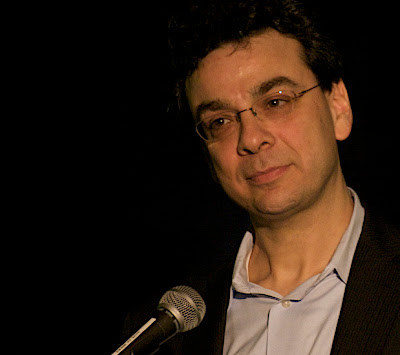
Stephen Dubner: Unexpected consequences

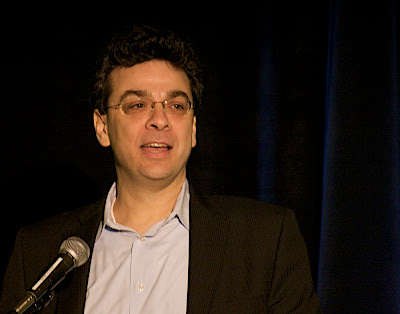
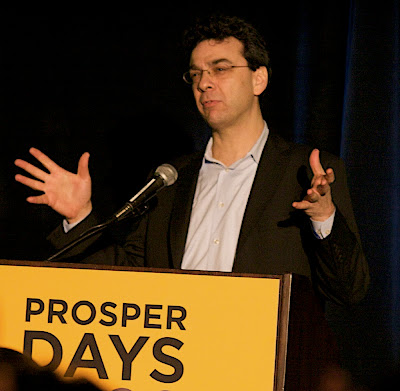
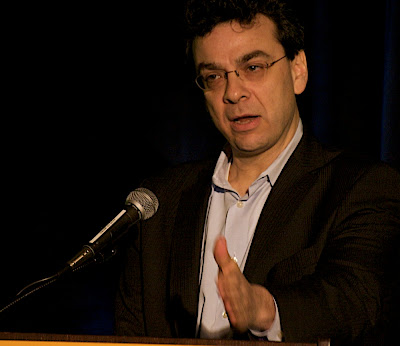
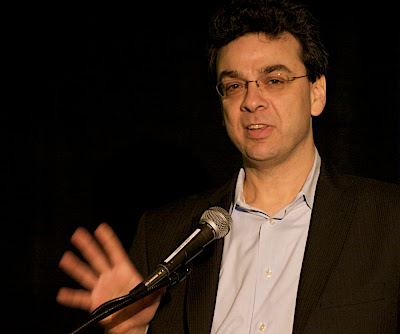
The keynote speaker on the second day of Prosper Days was Stephen Dubner, co-author (with Steven Leavitt) of Freakonomics: A Rogue Economist Explores the Hidden Side of Everything, author of Turbulent Souls: A Catholic Son's Return to His Jewish Family, Confessions of a Hero-Worshipper, and a children's book. Obviously it was Freakonomics that brought Dubner into the Prosper fold. Or at least to the podium. He connected his work to Prosper members by describing research on altruism, picking up on the "people helping people" theme.


Dubner is a likeable, funny guy, and an excellent speaker. He's clearly been at this for some time. In his presentation for Prosper Days he focused on the same general topic, the overarching topic, of Freakonomics: the study of incentives, but zeroed in particularly on the quality of research and how that quality reflects (poorly or well) real life.


Scrutiny tweaks the outcome. For example, there is a difference between "stated preferences" and "revealed preferences". If the people in a room are asked to raise their hands if they wash their hands after using a public toilet close to 100% will raise their hands. If, instead, researchers slyly count the number of persons washing their hands after using a public toilet they find that about 30% do not. This difference obviously comes from a factor known as "scrutiny".


What are the rewards, Dubner asks, for truthfulness? What is the cost of dishonesty? These are the questions that bring us a true understanding of incentives.

Gaming the Altruists . Dubner applauded the Prosper crowd for its apparent altruism. He then launched into the research on altruism in humans, taking us from "conventional wisdom" that says humans are innately altruistic (I am not sure how conventional that wisdom is, myself; I do not think humans are innately altruistic and don't know that I ever have) through the "Dictator Game" and beyond, to conclusions that, surprise surprise, vary with the rules of the game - the way the research is designed.


Who done it. The results of a research project are also affected by the person(s) doing the research. That is, the persons who interact with the research subjects. It turns out that no matter how well-designed the project is, the greatest cooperation will be obtained when requested by blonde women. I guess we all knew that already, though, didn't we?


Unassuming. Dubner kept coming back to the questions we ask and those we don't. Sometimes we have to ask questions in different ways at different times to separate ourselves from our own assumptions. Sometimes we don't think to ask the simple questions.

All of these elements affect the value of research. It's a mistake to rely upon research until you have reviewed how it was done and by whom.

Dubner's speech drew upon elements of the next book he and Leavitt plan to publish in about a year. Throughout his talk he referred to works by others, notably Predictably Irrational: The Hidden Forces that Shape Our Decisions, by Dan Ariely. Dubner's message, overall, was to question not only authority but also conventional wisdom when trying to predict the behavior of others or, for that matter, ourselves. We don't always or even often behave rationally. Perhaps by knowing some of the motives behind our own behavior we can prevent ourselves from making serious mistakes.