Wednesday, April 3, 2013

Checking In

I can now see if I have made any progress on the goals I have set.

First: Utilities. My goal is to get both gas and electric bills to stay on the baseline. No tiers. To date the gas has stayed there but electricity even hit tier 3 this last month! Fortunately, my daughter happened to notice that my freezer had not been closing right when she closed it. She took some things out and it closes again. It is possible that this has been happening for a while and I did not realize it. If so, I should see some difference in next month's electric bill.

Groceries: The goal I set on March 1:My modest goal for March: bring the three-month total down to $18 per day. To do that, I will need to spend no more than $509 this month on groceries.  Groceries for March were $354. An average of $11.42 per day. Nice work. I know some of that savings came from my eating things that were already in my cupboard or freezer, and some from occasionally eating out. My goal for April is to maintain spending at $15 per day or less.

Shopping: My goal for the first week of March was to spend nothing on "shopping". Now, "shopping" does not include spending on things like dish detergent or new plates or other household things, for example. It also does not include gifts that I buy for others.

I met that first goal, then set another for the next week of no more than $25 for the week. I chose to stay with this goal, deciding that if I do not spend the $25 it will carry over to the next week. This means I had a goal of spending about $75 on shopping last month. I spent $23.64. On books, as it happens. So, doing a rough rounding, that gives me an extra $50 for April, for a goal of $150.

Using cash. Another goal was to start using cash for some expenditures. I haven't done that yet. I'm still thinking about which would be the best category. Perhaps groceries.

Cable. I cut back my cable bill by eliminating premium channels. I don't know how that will play out in the final bill. I know I can do more.

Stocks. I am still working on this. I funded my new Options House account with money from selling some stock on buyandhold.com. When that money is available I will buy some Mattel primarily, and let it sit. I think, from reading the info on Options House, that I can do that. I don't think I have to keep buying every month.

So let's have a look at the graph for March:


Clearly, my house costs and health insurance are big numbers. And once again, my transfers to stock investments do not show up. Fees and charges is a bigger number than it should be. Part of that comes from credit card debt. It is probably time to do an analysis of that debt and work on paying down the card with the highest interest rate.  That will be the next thing I work on.


Wednesday, March 13, 2013

I am weak, I am weak

Today I changed my services on Charter. My last bill was $239.50. I decided to cut out the phone and the premium channels. I found a way to do it by using the chat box on charter.com. In the end I went for another package that still includes the phone for about $135 plus taxes etc. I suspect that it will be about $155 when all is said and done, maybe even more. So I may be back to cut out something else.

I really don't need the television but I am addicted. I have given up watching the premium channels just so I could be ready when this day came. I also have a Roku and signed up for Netflix Streaming as well as Hulu Plus (about $8 each per month). I watch through the Roku most of the time. For that I need internet. When I am stronger I will cut out the television altogether and just have internet.

Tuesday, March 12, 2013

Taking Stock

So here is what my spending looks like so far this month:

Only thing is, it's deceiving. It does not include money spent on stocks. That's more like a "transfer" from one account to another. I hate to say how much I have spent on trade commissions last year, considering the tiny amounts of stock I have purchased. I hate to say it, and I even hate to know it, but unless I do know it I won't know if I have changed. So I am going to know it. I am going to look it up right now.

I spent $139 on trade commissions last year, according to my records. I suspect this is not the whole amount, that I have miscategorized some transactions.  As I go through my records I will refine the number. What I do know is that I spent $119.76 in buyandhold.com fees last year ($9.98 per month, three "buys"), and $144 for sharebuilder, so the total is actually $263.76.

Here's what I've been doing. I've been buying bits of shares from buyandhold.com for three companies. I just buy a total of $80 worth of stock. But the fee is $6.99 for the first two and then $2.99 for each additional, so that means $9.98 every month to buy $80 worth of stock. Not a good ratio. Obviously I would do better to buy larger amounts, but I can't afford larger amounts. And I pay the $6.99 every month regardless.

I also buy stock from three companies on sharebuilder. I buy a total of $150 for a total fee of $12. A better ratio. I'm considering consolidating. Just have one account. But which one? I don't know.  I just opened yet another account (not funded) at OptionsHouse. Different type of account from Sharebuilder and Buyandhold. I need to fund it first. I have to give this all some thought.

Friday, March 8, 2013

What Now?

I have reigned in grocery and "shopping" so far this month so that neither is a big player. This, however, is what my spending looks like:

My home expenses include space rent, mortgage payment, and insurance. The insurance payment is due every quarter, so is not a monthly expense. The bills and utilities include cable (internet, television, home phone), gas, electricity, and trash. My cell phone bill has not arrived yet.  Taxes is property tax, a twice-yearly payment.

Health & Fitness so far includes a payment on a bill owed to my periodontal dentist for tissue grafting (I do not carry dental insurance; it doesn't work out for me), AARP supplement medical insurance, and a bottle of iron supplements required for upcoming surgery.

Gifts and Donations include donations to various groups, a gift for my daughter's birthday, and money into savings and college funds for one of my grandsons.

So far I have spent just $59 on groceries (less on coffee and restaurants). So I have stayed well within my goal of $18 per day, in large part because I have been eating what's in the cupboard. I have what I call a "scarcity complex" - I like to have food set aside for "emergencies" or just tough times. But lately I have enjoyed using up a lot of the canned beans and other things because I want to reorganize my cupboards and use my pressure cooker more.

In any case, there are a couple of glaring items: the cable bill, which is about $230. It creeps up all the time. I have been weaning myself off the premium channels so it is time to let them go. Gradually I will let go of the rest of the channels as well. And if it makes sense financially I'll get rid of the home phone.

My goal for this week is to reduce the cable bill, spend for groceries at $15 per day max, and spend on shopping no more than $25 for the week.

Tuesday, March 5, 2013

Using Cash

As a rule, I prefer to use my debit card over using cash. It is easier to track expenditures. However, I can get receipts, I do get receipts, and I look at those receipts anyway, so using cash should not be a huge deal for me. I am now considering moving some of my purchases to cash. Possibly groceries, likely restaurants, fast food. Figure out what I can spend each month and put it in an envelope. An easy way to track this money is to take it out and immediately categorize it "groceries" or whatever it is on Mint.com.

This is what LearnVest advises in this photo essay. There are a couple of other things in that list that I want to pay attention to that will be the subject of other articles.


Oh, by the way, LearnVest is similar to Mint, an accounting online tool. It is specifically aimed at women but of course can be used by anyone.  I opened an account there to try it out and I found one thing helpful: if you have some sort of account that is not included in their list, you can add it yourself and upload transactions manually. You can't do this in Mint: If the account is not working for some reason that you can't fix, you can't force it. However, Mint does have a great many more accounts on their list and I have become very comfortable there, so I continue to use it.


Saturday, March 2, 2013

Shopping

"Shopping" is a big catch-all. It includes shopping for clothing, hobbies (sewing and photography), kitchen equipment, even furniture. This heading does not include household equipment and supplies, things like that. Can I make any goals that make sense of it? I think I can.

Others have pledged to have a shopping-free week or month or whatever. I think this could work. Most of the shopping I do is online. I am drawn to the discounts. Not as much as others, I suspect, but I still get caught up in the promise of saving a few dollars. I would save a lot more if I skipped the purchase altogether.

So I am going to start small. A shopping-free week. Starting yesterday, the first of March.

Let's look at my record for last year:

I bought some big-ticket items last year because I had a little extra money. I bought an expensive camera, a few lenses, some extra equipment. So that does skew things. I won't be doing that kind of shopping this year. Nevertheless, here is what the numbers say:

Last year: I spent $10, 333 on "shopping". That's an average of $199 per week or $861 per month.

Last two months:  $487.56  Way under last year's average. $55 a week.  Some of that could go into savings or into paying off credit cards.

The goal for this week is 0.

Friday, March 1, 2013

Groceries

I have been thinking a lot about groceries lately. How much I spend on them, ways to reduce that amount. I have had an account on Mint.com for over a year so I have last year's records all neatly compiled. There are still a few mistakes and uncategorized items but the vast majority are correct. That's why I know that last year I spent an average of $20 a day on groceries. That's $140 a week. This doesn't count eating out, of course. I'll deal with that another day.

One way to cut back on groceries is to reduce the number of processed foods I buy. Sometimes processed foods - by which I mean frozen or refrigerated ready-to-eat-quickly foods - are just what I need. When I can't stand to cook anything I can usually throw something in the microwave, and really, that's cheaper, usually, than eating out. However, these meals are usually not the healthiest I could eat, so I have another motivation for cutting back.

I have been reducing the number of veggie meats and cheese I buy, in particular. These items tend to be pricey and do not have real health benefits (except as compared to animal meats and cheeses, which I do not buy at all).

I also purchased an electric pressure cooker and a juicer this year. I have been making good use of them both.

Some things affect the total:
* when I am in Las Vegas visiting daughters I often buy groceries for several of us.
* I bought a Groupon for a vegan food delivery service (frozen food) that kept me using the microwave for several days - I think I bought the Groupon in December but I've been using it just recently, so it is not included in the totals this year.

So, acknowledging that such calculations are not perfect, how am I doing so far this year?

In January and February I spent $1111.35 on groceries.  That's $18.82 per day. Down from last year, so far. My modest goal for March: bring the three-month total down to $18 per day. To do that, I will need to spend no more than $509 this month on groceries. Honestly, you'd think a single person would have no problem with that! And yet.


Thursday, February 28, 2013

Utilities

Expenses. I aim to reduce my expenses. To do so, I need to know what I am paying, so I can set goals.

I'm starting with an item that isn't much of a hot button: utilities. I pay "submetered" gas and electric bills along with my space rent each month. I live in a mobile home park. This means that somebody checks my meters once a month, and it isn't always consistently on the same day.

I have created a spreadsheet showing my gas and electric bills over the past year, compared to this year:


Variables to consider:
* Meters not checked consistently every month
* Weather affects use of gas especially
* Utility companies increase rates from time to time
* I travel, sometimes for ten days to a couple of weeks

I want to reduce my electric bill especially. Even though I feel I use gas more, it costs less, so I am less concerned about it. To that end I have started to shut off my computer every night (I had been leaving it on just about forever) and I am trying to curb my daytime television habit (something I picked up when recuperating from my first knee replacement). This is a vague goal but a goal nonetheless. I started making these changes some time in February, so my March bill may reflect the change. Let me go look (I haven't paid it yet but will in the next couple of days).

Hmmmm. The electric bill is $77.90 (gas is $49.74). Sheesh. The gas bill is way up. That may be because I got my heater working and I reveled in its warmth, keeping it at 72 degrees and even higher. The weather was also unusually cold. So far not what I'd call progress.


Resurrection Time

I am back. I'm taking this blog to the next level: getting serious about my money. Watch for revelations! Hear me cry!

I am going to reveal here as much as I can stand of my present situation, in the hopes that I will find ways to reduce my spending and get my income to exceed my outgo. Yes! You heard it here first!

Tuesday, April 8, 2008

Mail from Lending Club

I got this in my inbox today:

Dear Judith,

Lending Club has started a process to register, with the appropriate securities authorities, promissory notes that may be offered and sold to lenders through our site in the future. Until we complete the registration process, we will not accept new lender registrations or allow new commitments from existing lenders. We will continue to service all previously funded loans during this period, and lenders will be able to access their accounts, monitor their portfolios, and withdraw available funds without changes.

The borrowing side of our site will remain generally unaffected by this registration process; borrowers can continue to apply for loans and new loans posted after April 7, 2008, will be funded and held only by Lending Club.

Until the registration process is completed, the company will undergo a quiet period and will not be able to respond to press and other inquiries about Lending Club or the registration process during that time.

Q&A:

Q1. What about money I have begun moving, but is still in transit to Lending Club?
A1.1. If you are in the process of verifying your bank account, you will be able to complete that verification but will not be able to add new funds
A1.2 If you have initiated a transfer, the funds will be displayed in your Lending Club account balance as soon as those funds are available.
A1.3 If you have uncommitted funds, you may request that Lending Club return those funds via the same method used to load the funds. For example,
• If you have initiated an ACH to add funds, these funds will be transferred into your Lending Club account but you will not be able to lend these funds out. You can go into your Lending Club account once the ACH transfer has been completed and withdraw funds back into your linked bank account..
• If you've wired funds into your Lending Club account and have not yet committed these funds into loans, you can send a request to support@lendingclub.com for us to wire these funds back to you at no charge.
• If you've sent funds by check, and have not yet committed these funds into loans, you can send a request to support@lendingclub.com for us to send you a check by mail for the same amount at no charge.

Q2. What about referrals?
A2.1 The current referral program is terminated. If you have referred someone who has already signed up as a lender or a borrower, or if you have been referred by someone and have already signed up as a lender or a borrower, you will be receiving your referral payment within the next few days.

Sincerely,

Patrick Gannon
Senior Vice President
Lending Club
440 N Wolfe Road
Sunnyvale CA 94085
www.lendingclub.com


What this means is that uncommitted money I have in my account can't go to work there. I have to take it out to get it working, for an unspecified amount of time. What it means is no more referrals. And all this is out of the blue. I'm not impressed. But I've got his address. And so do you.

Friday, March 28, 2008

Credit unions: why I am considering a move

The other day I received a notice from my bank - Washington Mutual - that five debits had not cleared my account and therefore I was charged $30 per transaction for the overdraw - a total of $150. I discovered the problem when I was glancing at my accounts for another reason, before I got a notice from the bank.

I made a mistake. I have two checking accounts there and each has a debit card. Somehow the card I normally use had gotten shoved down in my wallet and the other one, which I normally do not use, was staring out at me. I used the wrong card for those transactions and therefore overdrew that account.

I wrote to the bank to ask

1) why don't they let me know the day the overdraw occurs, and
2) how about reversing some of those charges.

They wrote back. Sorry can't reverse the charges. For my convenience they did overdraw the account rather than bounce the checks.

I wrote back. What about my first question? And why are your fees so ridiculously high?

The answer: WaMu does offer the option of sending alerts. The message went on to describe how to set it up to get alerts. Fees are always being reviewed to be competitive with the industry.

Of course I already get alerts. Just not in time. And fees being set to be competitive? How about setting them to draw customers or keep the ones you have? The messages clearly were standardized. I guess the person answering picks out a couple of key words and sends the appropriate response.

In other words, I got no satisfaction. My daughter Elaine mentioned that she is looking into getting a credit union account instead because of the ridiculous fees and the delays in clearing checks whenever she and her husband deposit a large check.

I am now in the midst of choosing a credit union myself. What I hope to find is one that offers the options I find most valuable - free billpay, for example - as well as better rates for savings and lower fees for everything. My first step was to go to bankrate.com.

Bankrate.com offers a page: Six ways to find a credit union. For me, the big find on this page was CUNA: The Credit Union National Association.

On this site I found a page that helps one find a credit union. Because I am not employed right now and do not belong to any organizations (other than animal rights and eco types) or to any church, I simply entered my city, county, and state. Five matches turned up. I am now set to evaluate those matches.

Saturday, March 22, 2008

Freakonomics, by Steven Levitt and Stephen Dubner


Levitt and Dubner repeatedly say that this book does not have a "theme". And in the sense that Blink or The Tipping Point have themes, they are right. But it does have a fundamental focus: on "conventional wisdom".

Levitt, as an economist, has made his name by asking different questions - like "do teachers cheat?" - and by finding ways to sort data to get the answers he is looking for. Dubner interviewed Levitt for a NYT article a while back and soon a collaboration was born - the collaboration that yielded this book. Both Levitt and Dubner appear to be good writers, as evidenced by the Freakonomics blog at http://freakonomics.blogs.nytimes.com/, where both post individual as well as joint articles. I sense that the overall style of the book is more Dubner than Levitt, based on my seeing Dubner speak at Prosper Days (see my articles on Prosper Days at http://fightdebt.blogspot.com/search/label/Prosper%20Days).

In this book we find answers to a wide range of questions that few people would think to ask, about topics from sumo wrestlers to parenting. What does it have to do with economics? Simply that it has to do with how people get what they want - and how people can be encouraged to do the right thing and avoid doing the wrong thing. The outline of the entire book can be found in Dubner's original article, which is included as part of the additional material in this book, along with selected blog posts and heavy-duty footnotes.

I for one really did want a bit more of a theme than this non-theme, but I do think the basic premise is sound and a good reason for people to read the book - it is important to question conventional wisdom. For example, at one point another economist read Levitt's original article on the relationship between abortion and the drop in crime, and he said (I'm paraphrasing), "I have read this over and over and I can't find anything wrong with it, but I still don't believe it.". This is how most of us are: we can be faced with incontrovertible evidence but we find it difficult to let go of what we have believed for so long.

Portfolios: Prosper vs Lending Club

*edited 3/26/08
I recently joined Lending Club and added $500 to my account. I received an incentive deposit of $50 - I think because I joined through someone else's link. (You too can get an incentive when you join - click on the link to the right.)

Today I created a portfolio on Lending Club. I have six portfolios on Prosper. Here is a quick comparison of the two:

Lending Club:

There are actually two types of portfolios on Lending Club. The notes below apply to the automatic portfolio, known as LendingMatch. The other type is formed when you choose individual loans.

  • $500 minimum for each portfolio
  • Choice of "risk levels" from low to high but no other options
  • $25 bids on each loan are automatically set - that is, the portfolio automatically bids $25 on each loan that fits the criteria. You can change the amount of each bid when you "review" the portfolio.

Prosper:

  • No minimum for each portfolio
  • Wide range of options in addition to risk levels. Can choose to exclude "auto funding", can set no. of delinquencies that are acceptable, can choose to include only those loans that friends of the borrower have bid on, for example.
  • You choose the minimum bid ($50 or more).


What then?

On Prosper, it takes several minutes before a portfolio chooses loans that meet the criteria. On Lendingclub a list of loans is chosen immediately and you can select some from the list to delete if you like. (On Prosper you can't withdraw from a bid that is placed automatically by your portfolio.)

It takes less time, then, to set up a Lending Club portfolio and you get immediate results. On Prosper, though, you can add more criteria to tailor the loans you make. What works best for you obviously depends on your goals and preferences.

Friday, March 7, 2008

Lending Club


At Prosper Days I learned of a couple of other new "peer-to-peer" lending companies. One is loanio, which has not yet gone live. Another is Lending Club. I just joined Lending Club, in part as a diversification strategy and in part to find out what it's like.

Lending Club is similar to Prosper in its overall makeup: people lend to other people. Specifically, Lending Club makes loans and sells them to individual lenders, just like Prosper. There are, of course, differences. Lending Club only accepts borrowers with credit scores of 640 or higher, and may reject those if their credit balances are too high.

Acceptance as a lender is also similar to Prosper, except that instead of a checking account a lender can wire money to Lending Club. There aren't other options, like credit cards, yet.

Borrowers and lenders pay fees to Lending Club, based on the value of the loan. My quick glance tells me the percentages are higher than Prosper's.

Lending Club offers portfolios too, although some of the criteria differ from Prosper's.

I will offer more details in future posts.

Sunday, March 2, 2008

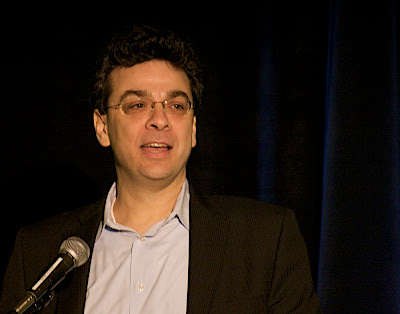
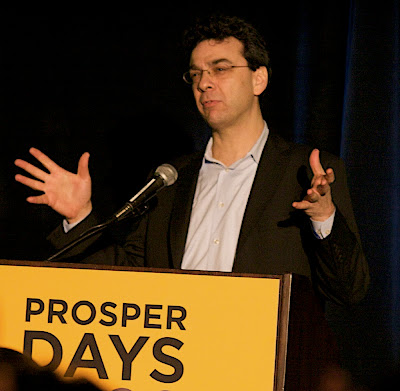
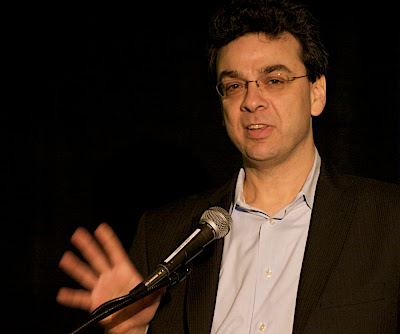
Stephen Dubner: Unexpected consequences

The keynote speaker on the second day of Prosper Days was Stephen Dubner, co-author (with Steven Leavitt) of Freakonomics: A Rogue Economist Explores the Hidden Side of Everything, author of Turbulent Souls: A Catholic Son's Return to His Jewish Family, Confessions of a Hero-Worshipper, and a children's book. Obviously it was Freakonomics that brought Dubner into the Prosper fold. Or at least to the podium. He connected his work to Prosper members by describing research on altruism, picking up on the "people helping people" theme.


Dubner is a likeable, funny guy, and an excellent speaker. He's clearly been at this for some time. In his presentation for Prosper Days he focused on the same general topic, the overarching topic, of Freakonomics: the study of incentives, but zeroed in particularly on the quality of research and how that quality reflects (poorly or well) real life.


Scrutiny tweaks the outcome. For example, there is a difference between "stated preferences" and "revealed preferences". If the people in a room are asked to raise their hands if they wash their hands after using a public toilet close to 100% will raise their hands. If, instead, researchers slyly count the number of persons washing their hands after using a public toilet they find that about 30% do not. This difference obviously comes from a factor known as "scrutiny".


What are the rewards, Dubner asks, for truthfulness? What is the cost of dishonesty? These are the questions that bring us a true understanding of incentives.

Gaming the Altruists . Dubner applauded the Prosper crowd for its apparent altruism. He then launched into the research on altruism in humans, taking us from "conventional wisdom" that says humans are innately altruistic (I am not sure how conventional that wisdom is, myself; I do not think humans are innately altruistic and don't know that I ever have) through the "Dictator Game" and beyond, to conclusions that, surprise surprise, vary with the rules of the game - the way the research is designed.


Who done it. The results of a research project are also affected by the person(s) doing the research. That is, the persons who interact with the research subjects. It turns out that no matter how well-designed the project is, the greatest cooperation will be obtained when requested by blonde women. I guess we all knew that already, though, didn't we?


Unassuming. Dubner kept coming back to the questions we ask and those we don't. Sometimes we have to ask questions in different ways at different times to separate ourselves from our own assumptions. Sometimes we don't think to ask the simple questions.

All of these elements affect the value of research. It's a mistake to rely upon research until you have reviewed how it was done and by whom.

Dubner's speech drew upon elements of the next book he and Leavitt plan to publish in about a year. Throughout his talk he referred to works by others, notably Predictably Irrational: The Hidden Forces that Shape Our Decisions, by Dan Ariely. Dubner's message, overall, was to question not only authority but also conventional wisdom when trying to predict the behavior of others or, for that matter, ourselves. We don't always or even often behave rationally. Perhaps by knowing some of the motives behind our own behavior we can prevent ourselves from making serious mistakes.

Saturday, March 1, 2008

Prosper transparency

Another apparent theme at the Prosper Days conference was "transparency" - the term that has come to mean a willingness to share the guts of an operation openly. Prosper's most obvious claim to transparency is the availability of its programming and data. By making this resource available to third parties, Prosper expands its own visibility. Several developers have taken advantage and are offering different ways of viewing and using the data.


Software engineer Eric Petroelje

Eric was tapped as panel leader or member more than once at Prosper Days. His expertise in software development allowed him to take advantage of the Prosper API (application programming interface) to indulge his other passion: investing in stock and real estate as well as Prosper lending. Eric created ericscc.com (Eric's Credit Community), a source of market information and lending statistics for lenders, and fantasy prosper, a market simulation tool for lenders. Tools like Eric's give investors additional information on how Prosper is doing in general as well as information on individual lenders and borrowers (not by real name but by Prosper member name). I was able to look up the difference between the number of bids I make and the number I win, for example. I just noticed that Eric has posted a list of the 25 borrowers with the greatest number of endorsements. It might be a good idea for me to use this list for bidding.


Carnegie Mellon Professor Doctor Robert Hampshire

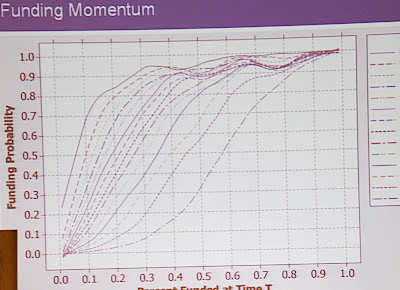
Dr. Hampshire offered a glimpse of the academic uses of Prosper data. He is leading a team, including a doctoral candidate we met the first day, in developing statistics on Prosper lenders. He offered some glimpses at the results so far, in the form of charts.


This chart shows the "tipping point" when a loan is expected to "go all the way". When bids on loans are tracked through time, those that reach 40% of funding tend to go all the way to 100%. In other words, when lenders see that a loan is 40% funded they are likely to bid on that loan and bring it all the way up.


Chief technology Officer and Co-Founder John Witchel and Chief Financial Officer Kirk Inglis

At most or all of the sessions, Prosper executives hung out at the rear of the room. They spoke up if someone on a panel gave out the wrong information and they readily answered questions. Prosper members are not a lightweight group - I don't think most of us would do this sort of thing if we didn't have the guts to take a chance on an idea - and often members would ask pointed questions that revealed more about the company than the presentations did. I was pleased to see how easily and openly Prosper executives fielded the questions. I think the reason they did not have to hesitate or obfuscate is that they rely on member experiences, questions, and recommendations to improve the way Prosper works.

I have attended many conferences for many different reasons over the years. The transparency of this company really stood out in my mind.

Friday, February 29, 2008

The Group Phenomenon


One of the central ideas behind Prosper is groups. Whoever heard of a borrowing group? Or a lending group? Especially a group of middle-Americans, not high-flying Wall Street investors?

The initial idea was, as I understand it, to encourage the formation of groups of borrowers and lenders that would support each other. A borrower who belongs to a group could gain some additional credibility from that group as well as assistance in requesting a loan. Groups can be formed on just about any basis - people who ride bicycles, for example.

In addition to the groups, Prosper created open forums. Members can ask questions, offer advice to others, get to know other members here.

Both of these elements contribute to the "web 2.0" slant of the company.

Now that Prosper has been around an amazing two years, it's possible to find out how the group thing is working. It turns out that the larger groups offer no real benefit to members while the smaller groups offer significant advantages. It makes sense intuitively. It also turns out that many people do not join groups, being perhaps of an obstinate loner nature like me. Some aspects of groups have changed along the way, including the provision of incentives for group leaders (group leaders have gotten tiny percentages from loans in the past but this incentive may not be retained).

One way that groups can be especially helpful to borrowers is in the provision of endorsements and particularly endorsements with bids. When group members provide endorsements of borrowers and also bid on their loans, they are showing confidence in that borrower. Of course a borrower can get endorsements from any other Prosper member, not just group members, but chances are probably better if the borrower is a member of a group.

My own experience with groups is small. I joined Prosper initially as a borrower. I requested a loan and the request failed (no bids. none.). During the time my listing was active and after it closed I received many messages from group leaders. They offered suggestions to improve my listing and invited me to join their groups. I didn't find a compelling reason to join so I didn't and therefore cannot comment on what it's like to be in one. I do believe, though, that this concept is unusual - unique, probably - in the lending industry. It will be interesting to track it over a longer time period.

Thursday, February 28, 2008

Term of the Days: Social Capital

If there was a theme to the Prosper Days conference, it was "social capital".

The opening page of the prosper website currently says "Get great rates and help fellow Americans". Prosper CEO Chris Larsen described different types of investors in his keynote address as "George Baileys" (from A Wonderful Life) and "Gordon Geckos" (from Wall Street). Bailey is the bleeding heart who wants to lend to deserving people while Gecko looks to line his pockets with the hard-earned money of those same deserving people ("Greed, for lack of a better word, is good"). Larsen, co-founder of Prosper, said Prosper tries to serve both types. When it comes down to it, it doesn't matter to Prosper what people's reasons are for investing. Nevertheless, the company has from the beginning promoted community involvement; people helping people. And some of the recent changes to Prosper have again brought "social capital" to the forefront.


Prosper CEO Chris Larsen

Portfolio plans.
Lenders can create portfolio plans that target specific types of loans - conservative or aggressive, with interest rates over a certain number, for example. Once the plan is created, the plan will automatically seek out loans that meet the lender's criteria, and bid on them. The lender doesn't even have to be there.

Larsen highlighted changes in the portfolio plan options. Lenders can now choose from several "social criteria" as well: whether the borrower has endorsements from friends; whether those friends are "verified" (proven to be separate people from the borrower), whether any of those endorsers have bid on the loan. Statistically, borrowers who obtain endorsements from verified Prosper members who then actually bid on the borrower's loan do stand a better chance of being funded - and those borrowers are more likely to honor their commitment to repay the loan than those in similar circumstances who do not have endorsements by bidders.


Group leader Marilyn Paguirigan

And then there was Marilyn. Marilyn Paguirigan spoke at at least four Prosper sessions. She is the leader of Malana Ohana, a Prosper borrower-and-lender group, based in Hawaii, that has unique characteristics. Primarily of interest is that its leader knows all of the members personally. It is essentially family-and-friends who support each other. Marilyn's group exemplifies the community aspect of Prosper and she spoke highly and often of the benefits of social capital. Her group has a high rating (four out of five stars), indicating its borrowers rarely default. The success of the group indicates that community support and associated social pressure has value.

The "people helping people" aspect of Prosper is attractive to a great many people. Many of us feel good when we can actually see (and sometimes even know) who is getting the money we lend, and we feel even better that we are keeping the loans out of the hands of the greedy lender industry. Prosper funds, however, are housed in Wells Fargo Bank, which tells us that the industry is still getting its cut.

Monday, February 25, 2008

Prosper People


Last Monday and Tuesday my daughter Elaine and I attended the Prosper Days conference. It was enlightening in a number of ways. One of the surprises for me was the people we met.

The conference was on the fourth floor of the Parc55 hotel in San Franciso, a rather ugly newer hotel that provides all the amenities for such conferences. Spread around the open area were circular tables and chairs, where we sat between sessions and when we ate breakfast and lunch. This arrangement encouraged the meeting of others, and Elaine and I did meet new people each time we sat at one of these tables. People came to the conference for different reasons and brought with them very different experiences and intentions.


We met Sam at the breakfast on Monday. Stan is a doctoral candidate at Carnegie-Mellon University in Pittsburgh. He is doing research on Prosper lender patterns - what types of loans lenders prefer, when they bid, a number of other quantifiable patterns. He asked me my preferences and how I went about lending on Prosper and my answers were very much in line with "typical" lenders. To do this research he and his advisors are using Prosper-provided data that is freely available on the Prosper website. Prosper provides open access to its programming and data (not including, of course, actual Prosper member identification by name), known as its API (application programming interface). One of Stan's advisors was on a panel on API usage, illustrating the academic purposes for which this resource can be used.


We met Stanley a number of times during our time there. He is a gregarious, friendly guy who is disenchanted with his retirement plan. He is looking to find other ways to invest that provide a better return. After attending the Prosper keynote session he realized another way he could use Prosper: to lend money to his sons. They can register as borrowers, asking a ridiculously low interest rate, and he could be the only bidder. Keeping it all in the family. This way there would be clear records of his loans to his sons and if they pay them back on time they will establish credit for themselves. Win-win all around.


The Scotts were also interested in finding better ways to invest their money. Michael already had an account with Prosper and was knowledgable about the company and the experiences of others. His wife came along for the ride, essentially, and is considering investing some money of her own but wants her capital to be more liquid. She doesn't want to wait for the loans to be paid off to be able to use the money again. At this conference she learned that the loans are paid back month by month and many people pay off their loans early so she is looking at it more seriously.

We met other couples similar to the Scotts, where one was already a member of Prosper who wanted to introduce the concept to the other. One man we met is actually in the lending business and has taken an interest in bringing it home. When I commented on the outrageous interest rates banks and credit card companies charge he was ominously quiet.

The friendly and open nature of the other conference attendees we met turned out to be indicative of the group as a whole and of the company as well. And no, I wasn't paid to say this - although I freely admit that my attendance at the conference was free, because I registered as a blogger.

Sunday, February 24, 2008

Off to Prosper Days

I am leaving for San Francisco this morning. I want to be in my hotel in the afternoon, able to scope out the route to Prosper Days by cable car or trolley.

So far my investments in Prosper borrowers have made over 16% interest. That's not the long-term average for loans, mainly because once in a while a borrower defaults, so I don't expect to maintain it. But by making small ($50 each) loans I have indeed diversified so if one defaults it isn't going to be a biggie. I also don't have a huge investment in Prosper overall, so I am not getting rich.

I will be reporting on what I learn here.